
Control Roland Synths Beautifully
Check out our Roland showcase — first in a new series spotlighting pedal, synth makers.

If you own Roland gear, you already know the tension. The instruments are extraordinary — deep, capable, sometimes legendary. And then you try to actually program them. Small displays. Menu-diving. Parameters buried three levels down. Hardware programmers that cost as much as the synth itself, if you can even find one. The gear is brilliant. Getting at what’s inside it is not.
So I built a page for it: mididesigner.com/maker/roland
It’s a single home for the best community-made Roland layouts for MIDI Designer Pro X — Jupiter Xm, JD-990, Fantom X, D-50, RD-88, TR-6S, TR-8S, Boss Katana, VG-99, and a lot more. 51 layouts in total, from the modern Jupiter X ecosystem all the way back to ‘80s rack polysynths that never had a proper programmer to begin with. 77,000+ downloads between them.
And unlike the Chase Bliss page — where yasir built nine of eleven layouts — the Roland library is a multigenerational thing. To understand it, you have to start at the beginning.
Where it started: rainer
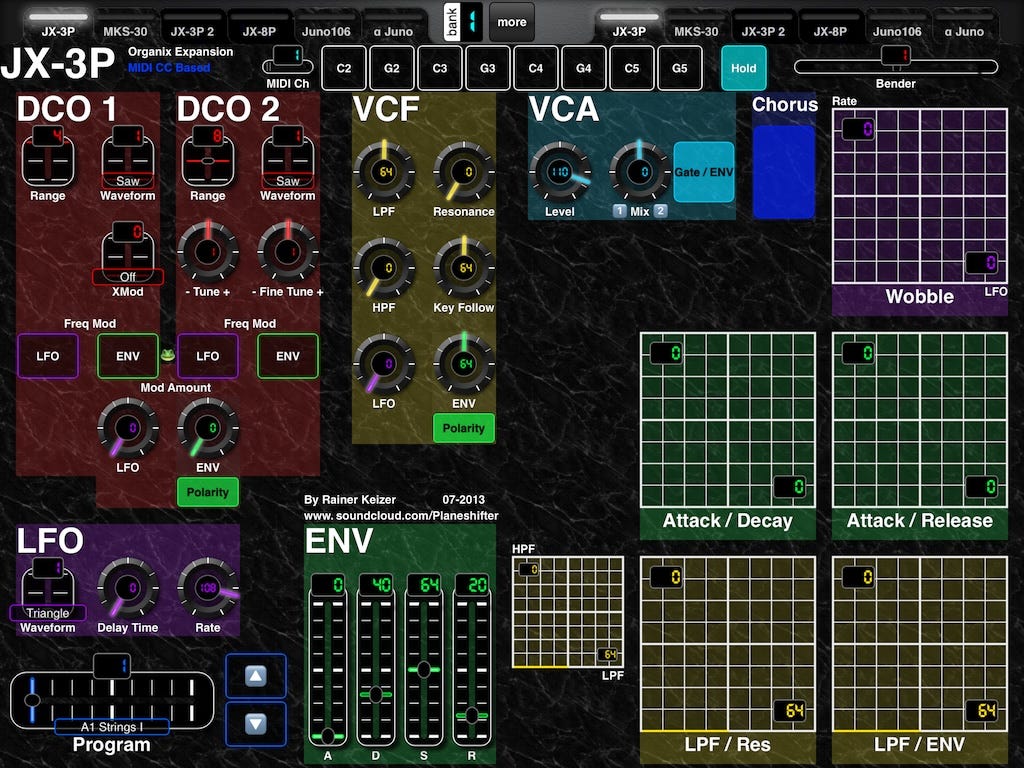
Every community has a founding document. For MIDI Designer’s Roland chapter, it’s rainer’s multi-synth ‘80s editor.
The layout covers the JX-3P (with the Organix mod and the KiwiTechnics upgrade), the MKS-30, the JX-8P, the Juno-106, the Alpha Juno 1 and 2, the MKS-50, and both the MKS-70 A and B — eight classic Roland polysynths, each on its own bank page, controlled from a single iPad layout. It was the first Platinum layout ever awarded in the MIDI Designer community. The description on the community page reads: “This layout inspired the entire Community to get to work. It’s not just a classic: it’s the first Platinum Layout ever, so it’s not just a work of art. It’s a trail-blazing work of art which inspired so many others.”
That’s not marketing copy. You can see it in the Q&A site, in the layouts that came after it, in the people who explicitly credit rainer as the reason they started building. deadbeatsynesthete, who later made a standalone Gold-rated JX-8P editor, wrote in his own post: “thanks to the awesome layouts that Rainer K made, I was really inspired to build one specifically for the JX-8P.”
Rainer also built the JX-10/MKS-70 with Vecoven PWM Kit layout — a Gold-rated editor specifically for units running Frederic Vecoven’s aftermarket firmware, exposing the expanded parameter set the upgrade adds. He’s mostly not hanging around the community anymore, but the foundation he built is still holding up the house.
The landmark: popup’s JD-990
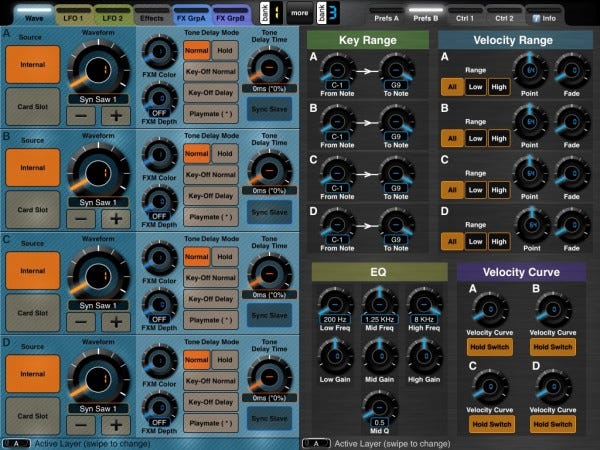
In December 2012, a community member named popup — Chris Gretton — posted a layout for the Roland JD-990 that redefined what MIDI Designer layouts could be (layout on Q&A Site).
The JD-990 is a 1990s rack module that Roland loaded with extraordinary sound design capability and then locked behind a small display and a programming workflow that discourages exploration. Editing patches on the hardware alone is genuinely tedious. The dedicated PG-1000 programmer for the earlier JX synths was itself a rare, expensive piece of hardware — owning one just to edit your own synth was a luxury many players couldn’t justify.
Popup’s layout opens all of it. Every parameter of the JD-990’s patch editing mode, mapped. Every waveform name, including every expansion card. Four-tone architecture, filters, effects routing, complex layering — all via SysEx, wirelessly, from an iPad. He went further: the layout ships in expansion-card-specific versions, so you download the one that matches your actual hardware configuration. Pop card, Orchestral, Piano, Vintage Synth, World, Dance, and more — twenty separate download variants so the layout matches exactly what you have.
The community description says the layout “redefined the boundaries of what’s possible with MIDI Designer.” That’s accurate. popup is MIA at this point, but the JD-990 layout is still there, still working, still one of the most ambitious things in the library.
The next wave: elkbeat and the Fantom X
Two years after popup’s JD-990 post, elkbeat built a Platinum editor for the Roland Fantom XR — and the story behind it is worth telling.
Roland had shipped desktop editor software for the Fantom X. Then newer macOS versions broke it, and Roland didn’t update it. The rack module’s own display is tiny, its knobs nearly unworkable for deep editing. Elkbeat needed to control his Fantom XR, found no working solution, and built one himself.
The result is a full-SysEx Fantom X editor covering patch management across six double pages (patch selector by bank, patch selector by category, LFO, TVF/TVA, MFX routing) and performance management across three more (parts 1-8, parts 9-16, performance effects routing). He used the Fantom’s own color scheme — red for patch management, yellow-green for performance. He drew the signal flow directly into the layout. When he posted it in November 2014, popup himself commented: “Looks fantastic Elkbeat!! I have a Fantom XR sat here begging me to have a play! Very tidy design there and the signal flow stuff is awesome.”
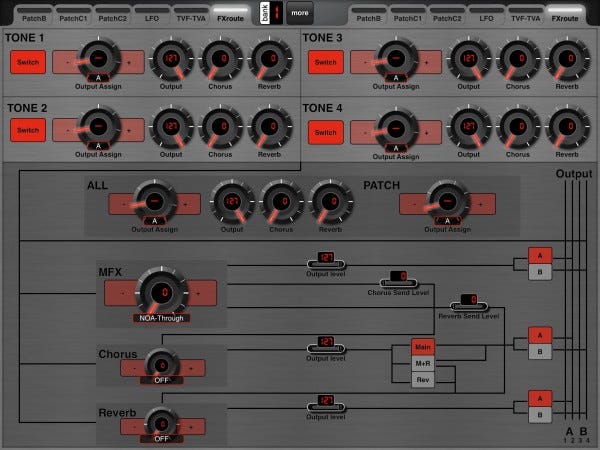
It’s a Platinum layout born from necessity. Roland dropped the software. The community filled the gap. Download the layout or see it on the Q&A site.
The modern anchor: jkhiser
If rainer built the foundation and popup set the ambition ceiling, jkhiser built the modern Roland library.
The numbers first: the Jupiter Xm Manager has over 10,600 downloads — the most-downloaded Roland layout in the community. The RD-2000 Manager has 9,180. The RD-88/RD-08 Manager has 6,238. Add up jkhiser’s downloads across the Roland library and you’re looking at a significant fraction of the 77,000 total. He holds two Platinum layouts, multiple Gold, and a string of Silver and Bronze — more layouts, and more heavily-used layouts, than anyone else in this ecosystem.
But the download counts don’t tell you what the layouts actually are. Here’s what he built:
Jupiter Xm Manager — Platinum, 10,600+ downloads. A multi-page editor for the Jupiter X/Xm covering tone editing, performance scene control, system settings, and SysEx-driven parameter recall — so when you load a scene, the sliders on the iPad mirror the hardware state. Also works with the Juno-X. It’s been through more than a dozen version updates; the version history reads like a product changelog.
Jupiter Xm ZEN-Core Editor — Platinum, 3,057 downloads. A deeper companion to the Manager that exposes the full ZEN-Core synthesis architecture — all four partials, per-partial LFO and envelope shaping, matrix modulation routing, structure settings. jkhiser’s own description: “a powerful, complex sound tool, trapped behind a small screen.” Use the Manager for performance, the ZEN-Core editor for real patch surgery.
RD-2000 Manager — Gold, 9,180 downloads. Stage piano control: tone selection, three-zone splits, effects routing, EQ, mixer view, program name loading. Updated to support the RD-2000 EX. Version history runs back to 2018.
RD-88 / RD-08 Manager — Gold, 6,238 downloads. The same treatment for the RD-88 and RD-2000, with dedicated pages for tone selection, splits, effects routing, and EQ — built for stage pianists who need to switch registrations mid-set without leaving the touch surface.
TR-6S Manager and TR-8S Manager — Gold. Drum machine control with live variation, pattern chaining, kit and pattern name display via SysEx, and stop-at-end. Real performance tools, not just remote controls.
Jupiter X-Xm ToneWheel Organ Emulation — Gold, 815 downloads. Live drawbar control, percussion settings, rotary-speaker MFX editing, and access to over 230 fixed drawbar presets. Hammond-style registration control for a synth that contains a tonewheel organ emulation most players never fully explore.
jkhiser is active, keeps his layouts current, and responds in the Q&A threads (and he also pitches in updating our manual and answering our most complex support queries). If you’re a Roland player and you pick up one of his layouts, you’re picking up something that’s been maintained.
The rest of the modern generation
The Roland library is too broad for any one person to cover, and the community around it reflects that.
thedood (Brett Anthony) contributed two of the most distinctive layouts on the page. His TB-3 Bassline controller — Platinum, 1,858 downloads — puts filter cutoff, resonance, envelope mod, accent, and slide on large touch-friendly controls. His description of the TB-3 is one of the best pieces of writing in the whole Q&A site: “Roland basically hid most of the synth in System Exclusive. It really is a full blown mono synth, with Ringmod LFO and twin Effects! Why they didn’t release an iPad controller/app etc. for it I have no idea as this thing is utterly WASTED without the extra Sysex control.” He also built a Gold-rated MC-303 controller — for the vintage ‘90s Groovebox, because of course he did.
gurbz owns the BOSS and guitar processor territory. His Boss Katana MK1 Bluetooth layout (Gold, 879 downloads) does something impressive: full wireless access to the Katana’s amp channels, boost, effects, and EQ via Bluetooth SysEx relayed through a Raspberry Pi — no USB cable to the amp, no bending down to the floor. He also built a GP-8 controller using StreamByter to resurrect full parameter access for Roland’s 1987 rack guitar processor, and a BOSS ME-5 layout for another piece of late-’80s floor gear. gurbz has a clear affection for old Roland/BOSS hardware that technically works but practically didn’t — and he keeps building the interfaces they should have shipped with.
thedood contributed two of the most distinctive layouts on the page:
Aira TB-3 Bassline — Platinum, 1,858 downloads. Filter cutoff, resonance, envelope mod, accent, and slide on large touch-friendly controls. His description of the TB-3 is one of the best pieces of writing in the whole Q&A site: “Roland basically hid most of the synth in System Exclusive. It really is a full blown mono synth, with Ringmod LFO and twin Effects! Why they didn’t release an iPad controller/app etc. for it I have no idea as this thing is utterly WASTED without the extra Sysex control.”
MC-303 — Gold, 1,331 downloads. Part selection, per-part effects, filter sweeps, and pattern triggering for the vintage ‘90s Groovebox — because of course he did.
gurbz owns the BOSS and guitar processor territory:
Boss Katana MK1 Bluetooth — Gold, 879 downloads. Full wireless access to the Katana’s amp channels, boost, effects, and EQ via Bluetooth SysEx relayed through a Raspberry Pi — no USB cable to the amp, no bending down to the floor.
GP-8 Guitar Effects Processor — Silver, 966 downloads. StreamByter-powered full parameter access for Roland’s 1987 rack guitar processor. Welcome back to 1987, with a 2021 upgrade.
BOSS ME-5 — Silver, 915 downloads. Complete effects parameter control for the late-’80s floor unit, via SysEx. gurbz has a clear affection for old Roland/BOSS hardware that technically works but practically didn’t — and he keeps building the interfaces they should have shipped with.
deadbeatsynesthete built a Gold-rated JX-8P editor — 1,170 downloads — that explicitly grew out of rainer’s foundational work. Patch creation and live performance on one layout, color-coded, built for hands-on sound design. The lineage is right there in the Q&A post: “thanks to the awesome layouts that Rainer K made, I was really inspired to build one specifically for the JX-8P.”
qdrtshlz covers the deep vintage rack end:
MKS-80 — Silver, 2,423 downloads. Recreates the MPG-80 control surface on-screen for a rack module that has no front-panel knobs.
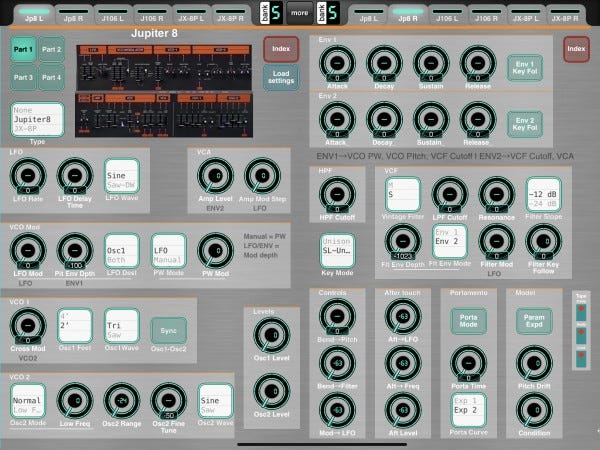
Jupiter-8 (Groove Electronics MIDI Mod) — Bronze, 633 downloads. For units with the 1987 retrofit that adds MIDI to a synth that never had it.
MC-202 (Tubbutec MC-2oh2 Upgrade) — Silver, 752 downloads. Modern touch control for a 1983 monosynth/sequencer via aftermarket firmware.
There’s a through-line in qdrtshlz’s work: gear that exists on the edges of what’s usable without aftermarket modification, now controllable from an iPad.
erikbojerik built the VG-99 V-Guitar System controller — Gold, 2,289 downloads. Extensive use of XY pads for real-time CC control of Roland’s guitar modeling system. One of the first layouts shared after the author became a MIDI Designer user in October 2012, and still one of the most aesthetically considered in the library — great color palette, great spacing.
bleunoir83 built the D-50 editor — Gold, 1,720 downloads — specifically because the PG-1000 programmer costs more than the synth itself. All 313 SysEx-addressable parameters, Upper and Lower tones, TVF, TVA, effects. The author’s own framing: “I bought MIDI Designer specifically to make a layout for my Roland D-50, because I was in love with its sound but appalled at its controls.”
How to actually use this stuff
Three steps:
Get the app. MIDI Designer Pro X from the App Store — works on iPad, iPhone, and Mac.
Connect. Apple device → USB MIDI interface → Roland Synth. Since it’s just MIDI, there are many wireless options, too.
Load the layout and start playing.
That’s it. The layout authors have done the hard work. You’re walking into a finished room.
What this page is for
The Roland maker page is the same thing the Chase Bliss page was: a clean front door. Find your instrument, see the featured layouts, grab one, and start controlling your Roland gear from an iPad, iPhone, or Mac.
Some of these layouts will have you up and running in five minutes. Others — the ZEN-Core editor, the Fantom X editor, the JD-990 — are genuinely deep tools that take time to explore. The work has already been done. You’re walking into finished rooms.
→ mididesigner.com/maker/roland
— Dan, JK and the MIDI Designer Team
MIDI Designer :: dream | create | play
One more thing
We just shipped MIDI Designer Pro X 10.15.0, which brings haptic feedback to iPhone via the Taptic Engine — knobs, sliders, buttons, crossfaders, and XY pads all have physical response now. If you’ve been using MIDI Designer on iPad and haven’t tried it on iPhone lately, this is a good moment.